This Op-Ed from the New York Times highlights some of the flaw of Chinese political culture, some flaws being that of "expediency and secrecy" as this article says. After a train crash killed 39 people in Wenzhou, the Chinese government had the system up and running the next day, all the wreckage piled carelessly on the side. The Chinese government instructed the media not to place too much emphasis on this accident, saying that anything regarding this accident should be about "great love in the face of tragedy." The Chinese people continuously argued about the issue, making it front and center. Something that the government clearly did not prefer at the time. Only after all of the pressure from the people and the media, did the government take this matter more seriously. As the article states
"At the very heart of all of these questions — and indeed of the tragedy itself — is a government that refuses to be held accountable for its decisions, and that admits no criticism when criticism might make the difference between bold vision and monstrous folly."
http://www.nytimes.com/2011/07/29/opinion/29iht-edbandurski29.html
Monday, March 18, 2013
Protests and the Future (Political Culture)
First off - Here is a really cool interactive timeline detailing some of the major events in China's last ten years.
http://www.guardian.co.uk/world/interactive/2012/mar/23/china-decade-change-interactive-timeline
If you look at the timeline, you will see more and more and more events under the "unrest, dissent, and politics" section. Now this may just be because of the growth of the 24 hour news cycle... or it could be a signal that there are some major calls for change in China that could be signaling a change in the Chinese people's political culture.
The following article from 2012 describes some of the changes in Chinese political culture and awareness. The protests signal a change in the people's viewpoint of government:
"If there's economic development it's not given by the government; it's [the people's] own labour and entrepreneurship. It is not the government that is creating wealth. It's society."This change in belief, as quoted from the Guardian article linked below, signals a change in thought, belief, and thus political culture. The people are coming to value new ideas on top of the ones instilled in them culturally by Mao and Confucius.
http://www.guardian.co.uk/world/2012/mar/18/china-challenges-next-generation
The past ten years as shown by the timeline signal a new change and the following articles urges for more in the next ten years. Only with time will we know how China will respond to the growing protest movements, new social awareness, and changing political culture.
Education in China (Social Lens)
Cost for education is especially high in China. Little government financial aid is given and scholarships are hard to get. Oh, and did I forget to mention? Cost for a year in college amounts to 15 months of a rural parent's average earnings.
It's a high stake game in China: investing in a child's education means forfeiting possible retirement funds at the hope that the child will find a job because of their high quality training.
The article below from the New York Times (possible bias...) describes one rural family's situation in China.
http://www.nytimes.com/2013/02/17/business/in-china-families-bet-it-all-on-a-child-in-college.html?pagewanted=all
Education is the foundation of society. Therefore, when examining China through a social lens, it is vital to examine the importance placed on education - which is obviously quite a bit. However, this article at least points to the fact that education is valued for parents for mostly economic and possibly some cultural reasons.
The Effect of the Melting Arctic Ocean on China (Economic Lens)
As many have heard recently, the ice that currently has made the North Pole and Arctic Ocean unnavigable is melting at a pace that a route will soon be available to make trade possible between China and Europe over such a route. The melting ice also means opportunities for oil and natural resources which are suspected to be in reserve under the ice sheet. As this offers significant economic opportunity, China sees vast opportunity available with a possibility of lowering costs and CO2 emissions because of a shorter route.
Below linked are two articles. One is a biased source from the one of the most popular Chinese newspapers, the China Daily, which according to Wikipedia publishes the official policy of the People's Republic of China (wikipedia article linked here - http://en.wikipedia.org/wiki/China_Daily). On a side note, I was inspired after writing my last post about censorship/propaganda/newspapers in China so I thought it would be interesting to see both perspectives of the issue here. The other article is from the UK newspaper, the Guardian, and discusses the issue from a less biased viewpoint - even discussing the "rocky relationship" (anyone get the reference?) between Norway and China as well as China's controversial interests in Greenland.
China Daily article: http://usa.chinadaily.com.cn/epaper/2013-03/14/content_16308665.htm
Guardian article: http://www.guardian.co.uk/world/2013/mar/18/china-arctic-mineral-investment
And just because the global warming is connected to all of this, here is a picture of some sad polar bears on a melting iceberg.
Anyways, the Arctic ice sheet melting opens a lot of economic opportunity, though, as the Guardian article suggested, could possibly cause some political conflict as countries compete to gain control of the sea passage and resources. However, if China gains control, it will in no doubt grow even more as a world economic power.
Below linked are two articles. One is a biased source from the one of the most popular Chinese newspapers, the China Daily, which according to Wikipedia publishes the official policy of the People's Republic of China (wikipedia article linked here - http://en.wikipedia.org/wiki/China_Daily). On a side note, I was inspired after writing my last post about censorship/propaganda/newspapers in China so I thought it would be interesting to see both perspectives of the issue here. The other article is from the UK newspaper, the Guardian, and discusses the issue from a less biased viewpoint - even discussing the "rocky relationship" (anyone get the reference?) between Norway and China as well as China's controversial interests in Greenland.
China Daily article: http://usa.chinadaily.com.cn/epaper/2013-03/14/content_16308665.htm
Guardian article: http://www.guardian.co.uk/world/2013/mar/18/china-arctic-mineral-investment
And just because the global warming is connected to all of this, here is a picture of some sad polar bears on a melting iceberg.
Anyways, the Arctic ice sheet melting opens a lot of economic opportunity, though, as the Guardian article suggested, could possibly cause some political conflict as countries compete to gain control of the sea passage and resources. However, if China gains control, it will in no doubt grow even more as a world economic power.
Newspapers in China (Political Lens)
Although we take the right of speech as a given in the United States, in China it is not so. In fact, individual rights in general were not incorporated as we know them when democracy in China first began to take root. In fact as we learned in class, Liang Qichao, the writer that introduced democracy in China, believed that "there was no difference between individual interests and public interests; individual citizens were granted rights in order to better strengthen the state" (the full article is linked here - http://www.tsquare.tv/themes/essay.html).
Taking this into account, it is no surprise that government severely limits freedom of speech through censorship in the People's Republic of China. Newspapers especially are a highly censored and controlled form of media.
The following BBC Q&A article addresses China's growing newspaper industry. Unlike many developed countries, the circulation of newspapers is actually increasing. It's largest newspaper, Reference News, has more papers circulating then the Wall Street Journal. The press is becoming more focused in lifestyle and entertainment (similar to the US). Sometimes it is prone to yellow journalism tactics to discredit other papers. However, all newspapers can only run with approval from the government. Recently, a Chinese newspaper, Southern Weekly, protested the censorship and propaganda policies of the Chinese government - asking the top propaganda official to step down. To read more about this, see the second article linked below.
BBC Q& A - http://www.bbc.co.uk/news/business-20970543
Guardian - Southern Weekly - http://www.guardian.co.uk/world/2013/jan/14/china-censorship-southern-weekly-incident
Looking from a political/governmental lens, censorship is the way that the government controls information and prevents its legitimacy from being questioned. Withholding information gives the government more control over the people and can elicit their support in a much more convenient question. With censorship and propaganda, it is near impossible for the media (and newspapers) to fulfill their role as the government's "watch dog." Hopefully, in the coming years, China will relinquish its tight control on newspapers and the freedom of speech.
Is China really that serious on corruption?
Corruption begins with C and so does China. It is undisputed that in the past, corruption has secretly been a major part of Chinese society. Now, with new president Xi Jingping, corruption may finally be coming to an end--a slow end but an end nevertheless. The question remains though on how hard Xi can crack down on corruption without losing his support. If he doesn't crack down corruption quick enough, he could lose the support of his citizens but if he pushes his Communist comrades to give up their power too quickly, he will lose their support. In essence, Xi Jingping will have a balancing act on what to do in order to do what he promised in his speech to end corruption.
http://www.bbc.co.uk/news/world-asia-china-21231198
Thursday, March 14, 2013
Tax Reform for China
China has decided to reform their tax system and some people just aren't too pleased with that. This new tax system is aiming to boost a sector that creates more jobs, less dirt, and almsot as much output as industry does. This specific reform extends China's value-added tax (VAT) to a variety of services. This reform has quickly spread to other cities and neighboring provinces. The tax now contributes a quarter of its revenues to the Chinese government and so far, has eased taxes by about $6.4 billion dollars. Many businesses have begun complaining because their taxes have increased significantly. Is this China moving towards a more capitalistic society? We'll just have to wait and see.

http://www.economist.com/news/china/21572802-chinas-most-underrated-sector-benefits-undersold-tax-reform-better-service-game?zid=306&ah=1b164dbd43b0cb27ba0d4c3b12a5e227
Tuesday, March 12, 2013
Christianity in China
Christianity is on the rise in China and the Catholic Chinese eagerly await the election of the new pope in the Vatican. In 1951, China cut ties with the Vatican and things between the two have not been able to overcome their rift. This, however, has not prevented the Chinese citizens from practicing religion in their homeland. Many practice their religion in churches that are monitored by the church, to the dismay of international rights groups, but others practice in underground churches, away from the government eye.
Even with the problems between practicing a religion and the government, it still remains a safehaven for many Chinese. For this reason, they await a new pope, one they hope will be able to mend the break between the Vatican and China.

http://www.cnn.com/2013/03/01/world/asia/china-catholics-florcruz/index.html
Even with the problems between practicing a religion and the government, it still remains a safehaven for many Chinese. For this reason, they await a new pope, one they hope will be able to mend the break between the Vatican and China.
http://www.cnn.com/2013/03/01/world/asia/china-catholics-florcruz/index.html
Sunday, March 10, 2013
A Look at Censorship in China's Political Culture
China was accused of jamming BBC radio broadcasts of its English international program. When questioned, the Chinese government responded with a typical combination of equal parts indignant dismissal and furtively ambiguous redirection:
With censorship being commonplace in China, the Chinese political culture has been historically much less open than in countries such as the U.S.. Many individuals who publicly oppose the government are punished severely and persecuted. However, in recent years with the increasing popularity of social networking sites such as Weibo, the Chinese population has become increasingly vocal in its criticism of the government online. Websites like Weibo, a microblogging site, allows for the younger generations to express their political opinion in a way that's public, but more undercover than proclaiming their criticisms on TV or in a book. The expansiveness of the internet and the public-ness of social media sites also allows for netizens to research and point out discrepancies of the government. Despite the impediments caused by the Chinese government's heavy use of censorship, China's burgeoning online culture points to the development of a more free, transparent political culture.
http://www.guardian.co.uk/world/2013/feb/26/china-accusations-jamming-bbc-broadcasts
"I don't understand this situation," foreign ministry spokesperson Hua Chunying said at a daily press briefing on Tuesday, when asked to comment on the allegations. She said reporters should contact "relevant departments" for further information, but did not specify which departments or how to contact them.Upon investigation of an apparent interference in the broadcast, BBC announced that its broadcast had been jammed in a way that indicated an organized, mass effort that was in line with what we've seen coming from China in the way of media censorship in the past. BBC's TV broadcasts have been known to suddenly cut off when addressing politically and/or socially sensitive issues, and the website is also often blocked. Other international media sources functioning in China have also suffered from similar interferences.
With censorship being commonplace in China, the Chinese political culture has been historically much less open than in countries such as the U.S.. Many individuals who publicly oppose the government are punished severely and persecuted. However, in recent years with the increasing popularity of social networking sites such as Weibo, the Chinese population has become increasingly vocal in its criticism of the government online. Websites like Weibo, a microblogging site, allows for the younger generations to express their political opinion in a way that's public, but more undercover than proclaiming their criticisms on TV or in a book. The expansiveness of the internet and the public-ness of social media sites also allows for netizens to research and point out discrepancies of the government. Despite the impediments caused by the Chinese government's heavy use of censorship, China's burgeoning online culture points to the development of a more free, transparent political culture.
http://www.guardian.co.uk/world/2013/feb/26/china-accusations-jamming-bbc-broadcasts
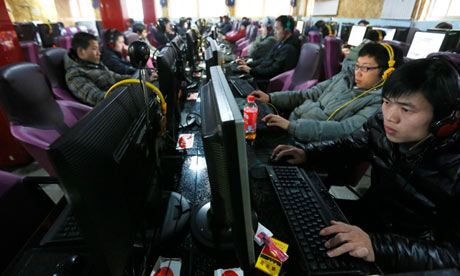
| An internet cafe in Beijing |
A Weak Start for the Economy This Year
Although China's burgeoning economy has helped the nation become a powerful international player within the last couple of decades, latest reports indicate that the economy has not had as strong of a start as projected so far in 2013. Inflation is on the rise and domestic spending is decreasing, but property construction is still strong. These recent statistics have left experts pessimistic about the rate of economic growth in China in the next few years and the government's target growth rate of 7.5%. One of the biggest economic issues that the Chinese government is dealing with right now is containing the real-estate market and a dangerous housing bubble that constantly threatens to re-inflate.
China's retail sales have also slowed in the first two months of 2013, with the slowest growth rate seen since 2004. However, it's also true that many of China's wealthy travel to and buy goods from foreign nations for Chinese New Year, where the goods are often not as expensive, so it's difficult to tell whether or not this is just a temporary drop.
In terms of connections to the political realm, drops in Chinese luxury spending may also be attributed to recent crackdowns on severe government corruption within the Chinese Communist Party, which may have resulted in less spending on expensive, high-end items by government officials.
http://online.wsj.com/article/SB10001424127887324096404578352112725013492.html?mod=googlenews_wsj
China's retail sales have also slowed in the first two months of 2013, with the slowest growth rate seen since 2004. However, it's also true that many of China's wealthy travel to and buy goods from foreign nations for Chinese New Year, where the goods are often not as expensive, so it's difficult to tell whether or not this is just a temporary drop.
In terms of connections to the political realm, drops in Chinese luxury spending may also be attributed to recent crackdowns on severe government corruption within the Chinese Communist Party, which may have resulted in less spending on expensive, high-end items by government officials.
http://online.wsj.com/article/SB10001424127887324096404578352112725013492.html?mod=googlenews_wsj
| The rate of retail purchases in China has decreased in the first two months of 2013 |
Education in China, as told by the Onion (hahaha.)
Report: Chinese Third-Graders Falling Behind U.S. High School Students in Math, Science
| Experts say the average Chinese third-grader is now, alarmingly, barely able to compete with a U.S. high school senior. |
The study, based on exam scores from thousands of students in 63 participating countries, confirmed that in mathematical and scientific literacy, American students from the ages of 14 to 18 have now actually pulled slightly ahead of their 8-year-old Chinese counterparts.
“This is certainly a wake-up call for China,” said Dr. Michael Fornasier, an IEA senior fellow and coauthor of the report. “The test results unfortunately indicate that education standards in China have slipped to the extent that pre-teens are struggling to rank among even the average American high school student.” ..........
http://www.theonion.com/articles/report-chinese-thirdgraders-falling-behind-us-high,31464/
Parting Words of Warning from China's Prime Minister Wen Jiabao
Despite the way the Chinese Communist Party seems to continuously deny and displace the blame when confronted with different issues in the past, government officials have been increasingly open when addressing relevant problems in China. In his last speech as the prime minister of China, Wen Jiabao discussed various issues that have developed as China has grown economically. He talked about the gaping chasm between the rich and the poor and the social tensions that are created because of uneven economic development. Also, Wen mentioned the issue of pollution and other negative environmental impacts of China's rapid economic development.
Considering its rise as a true economic powerhouse within the last several decades, China should naturally follow suit with equal progress in terms of environmental responsibility and attention to social issues. While it seems like this has not really been happening at a visible rate, the fact that a top Chinese government official brought public attention to these problems is indicative of slow but sure progress in the right direction.
http://www.nytimes.com/2013/03/06/world/asia/chinas-wen-gives-final-speech-as-prime-minister.html?pagewanted=all&_r=1&
Considering its rise as a true economic powerhouse within the last several decades, China should naturally follow suit with equal progress in terms of environmental responsibility and attention to social issues. While it seems like this has not really been happening at a visible rate, the fact that a top Chinese government official brought public attention to these problems is indicative of slow but sure progress in the right direction.
http://www.nytimes.com/2013/03/06/world/asia/chinas-wen-gives-final-speech-as-prime-minister.html?pagewanted=all&_r=1&
| Wen Jiabao, China's most recent prime minister |
Mentally Disabled in Chinese Society
Mentally disabled Chinese citizens have historically lived in the margins of society, oftentimes seriously abused and definitely lacking the kind of special outside attention and social acceptance that they would have here in the United States. However, thanks to China's rapid societal and economic development in the recent decades, mentally disabled individuals have found an increasing amount of support in local and online communities. On Weibo (China's microblogging equivalent of Twitter), one user made a post about a bakery called Ai De Bakery ("Amity Bakery"), which employs mentally disabled citizens as 1/3 of its entire workforce and thus effectively gives them a way to support themselves and teaches them to be productive members of society. This post quickly went viral and produced a huge outpouring of love from the online community, with many people offering words of support and encouragement and placing orders for bakery items.
In a country where the mentally disabled have generally been ignored and/or mistreated (with multiple cases as recent as 2011 in which mentally disabled individuals were being recruited and then sold and enslaved in factories), causes such as Ai De Bakery as well as awareness and support from social media are an encouraging step forward for the mentally disabled in China.
http://www.theatlantic.com/international/archive/2013/02/a-sanctuary-for-chinas-mentally-disabled/273495/
In a country where the mentally disabled have generally been ignored and/or mistreated (with multiple cases as recent as 2011 in which mentally disabled individuals were being recruited and then sold and enslaved in factories), causes such as Ai De Bakery as well as awareness and support from social media are an encouraging step forward for the mentally disabled in China.
http://www.theatlantic.com/international/archive/2013/02/a-sanctuary-for-chinas-mentally-disabled/273495/
| Ai De Bakery |
Saturday, March 9, 2013
Trust By Way of Execution
Four foreign prisoners were displayed on a live TV Chinese broadcast being led to their executions. These prisoners were convicted of murdering twelve Chinese sailors and the broadcast showed them being bundled up and shoved into police cars. Throughout the broadcast, images of the Chinese judicial force were constantly shown, inspecting the crime scene, arresting the prisoners, and conducting interviews about the Chinese Rule of Law. The Chinese government wants to let its people know that they are serious about protecting them whether it be inside or outside of the country so its a political play for the government to gain the trust of their people a little more.
http://www.guardian.co.uk/world/2013/mar/01/china-execute-mekong-river-murders
This is a picture of the broadcast and one of the convicted foreigners.
http://www.guardian.co.uk/world/2013/mar/01/china-execute-mekong-river-murders
This is a picture of the broadcast and one of the convicted foreigners.
Market Economy Leads to Marriage Markets
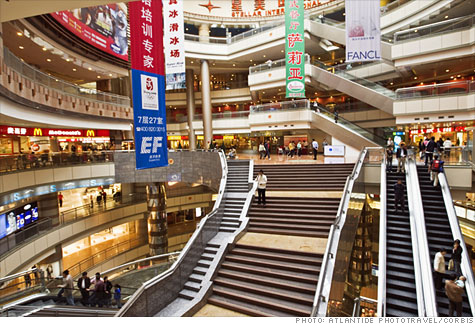
This article from the New York Times discusses an extremely interesting sociological conflict within China. Finding a spouse. Back in the day, it was a lot easier for people to find husbands/wives and get married because they only had a small radius in which to find them. There were tight controls over housing, employment, travel, and family life so finding someone to marry was not as difficult. Today, it becomes a lot harder because all of a sudden, those family connections and social circles are being torn apart as people uproot themselves from home and move to big cities for jobs. Now, the profession of "love hunting" is extremely popular. Love hunters are matchmakers who scour shopping malls and promenades looking for the right person for their client. In the article, it talks about a love hunter by the name of Yang Jing scouting women in front of H&M and she's being paid thousands of dollars by millionaires looking for a wife. Love hunting isn't just restricted to millionaires, many mothers and fathers of older men and women try to advertise their offspring in the hopes that they will get married someday. Men and Women are also trying online dating websites to find their prospective spouses since again, they're uprooted from their family life and have no other ways of meeting new people. Love hunting is now becoming a huge business in China thanks to the economic changes throughout generations.
http://www.nytimes.com/2013/03/10/business/in-a-changing-china-new-matchmaking-markets.html?pagewanted=2&ref=asia
The above picture demonstrates an informal marriage market, where mothers and fathers try to find spouses for their children. Many of these market dealings occur in parks throughout Beijing, this one is in the Temple of Heaven park.
http://www.nytimes.com/2013/03/10/business/in-a-changing-china-new-matchmaking-markets.html?pagewanted=2&ref=asia
The above picture demonstrates an informal marriage market, where mothers and fathers try to find spouses for their children. Many of these market dealings occur in parks throughout Beijing, this one is in the Temple of Heaven park.
Sunday, March 3, 2013
Possible Reform for China?
This article from the BBC focuses on an open letter that was signed by more than 100 people to urge Beijing to ratify an international human rights treaty. This want for political reform comes just days before the leaders in China gather for their annual parliamentary session. The treaty in question calls for "basic civil and political rights of individuals, including freedom of religion, freedom of speech and freedom of assembly". This treaty was signed in 1998 but has not been ratified by Beijing. If reform is not brought about, people have warned that a violent revolution may occur. It seems that that some people in China are becoming impatient with the government and the political circumstances. This call for reform brings into question whether or not China is ready for political reform within their society and how long this possible change could take.
http://www.bbc.co.uk/news/world-asia-china-21597752
Tuesday, February 26, 2013
Service Sector in China
http://www.economist.com/news/finance-and-economics/21572236-services-are-poised-become-countrys-biggest-sector-served-china
This article from The Economist, discusses how services or service jobs in China are becoming the largest percentage of China's GDP after 2012. "According to the national statistics, services (which include transport, wholesaling, retailing, hotels, catering, finance, real estate and scientific research, among other things) accounted for 44.6% of China’s GDP in 2012" (economist.com, 2013). China already has a rapidly growing economy and with the service sector growing, this could lead the country toward a stable economy with faster job creation and greater household spending which would bode well for the global economy as well.
Friday, February 22, 2013
Introduction to China
Hey Guys, here's some background information on the People's Republic of China
http://www.bbc.co.uk/news/world-asia-pacific-13017877
Subscribe to:
Posts (Atom)