"I don't understand this situation," foreign ministry spokesperson Hua Chunying said at a daily press briefing on Tuesday, when asked to comment on the allegations. She said reporters should contact "relevant departments" for further information, but did not specify which departments or how to contact them.Upon investigation of an apparent interference in the broadcast, BBC announced that its broadcast had been jammed in a way that indicated an organized, mass effort that was in line with what we've seen coming from China in the way of media censorship in the past. BBC's TV broadcasts have been known to suddenly cut off when addressing politically and/or socially sensitive issues, and the website is also often blocked. Other international media sources functioning in China have also suffered from similar interferences.
With censorship being commonplace in China, the Chinese political culture has been historically much less open than in countries such as the U.S.. Many individuals who publicly oppose the government are punished severely and persecuted. However, in recent years with the increasing popularity of social networking sites such as Weibo, the Chinese population has become increasingly vocal in its criticism of the government online. Websites like Weibo, a microblogging site, allows for the younger generations to express their political opinion in a way that's public, but more undercover than proclaiming their criticisms on TV or in a book. The expansiveness of the internet and the public-ness of social media sites also allows for netizens to research and point out discrepancies of the government. Despite the impediments caused by the Chinese government's heavy use of censorship, China's burgeoning online culture points to the development of a more free, transparent political culture.
http://www.guardian.co.uk/world/2013/feb/26/china-accusations-jamming-bbc-broadcasts
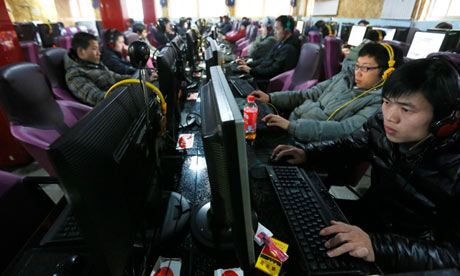 |
| An internet cafe in Beijing |

No comments:
Post a Comment